
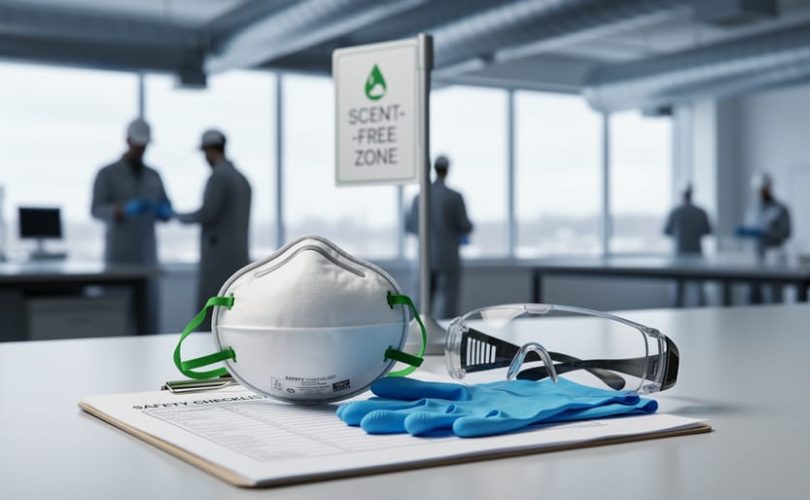
A workplace safety policy is a written framework that protects employees from hazards and ensures regulatory compliance. In 2026, Canadian employers must address harassment and violence through documented procedures, provide clear complaint mechanisms, and deliver mandatory training. These policies carry particular weight for workers with multiple chemical sensitivities who require accommodation for environmental triggers that most standard policies overlook.
Every Canadian jurisdiction now requires written workplace safety policies, yet confusion persists about what must be included and how to implement accommodations for chemical sensitivities. Recent updates to the Canada Occupational Health and Safety Regulations, modified in August 2026, signal growing attention to protective equipment standards. The Labour Program Forward Regulatory Plan through 2028 proposes further health and safety requirements for personal protective equipment, reflecting increased recognition that one-size-fits-all approaches fail vulnerable workers.
For employees managing chemical sensitivities, workplace safety policies represent both protection and potential barrier. A poorly designed policy might mandate fragranced cleaning products or require PPE that triggers reactions. A thoughtful one creates space for scent-free zones, alternative materials, and flexible work arrangements. Whether you’re an employer building a compliant framework, an HR professional updating existing documents, or someone with MCS advocating for safer conditions, understanding what makes a workplace safety policy effective is foundational to creating environments where everyone can work without compromising their health.
What Must Be Included in a Workplace Safety Policy for MCS

A comprehensive workplace safety policy addressing Multiple Chemical Sensitivity must include several mandatory components under Canadian law, plus specific provisions to protect chemically sensitive workers. Federal regulations and provincial frameworks require written documentation, clear procedures, and measurable accommodations that go beyond generic safety statements.
Every Canadian workplace safety policy must establish written rules to prevent harassment and violence including a formal complaint procedure that allows affected workers to report concerns without fear of retaliation. These foundational requirements apply across all jurisdictions and form the framework within which MCS accommodations operate. Training programs must educate supervisors and employees about their responsibilities under the policy, covering both general safety obligations and specific protocols for chemical sensitivities.
For MCS accommodations, your policy needs explicit provisions addressing exposure triggers. This includes a fragrance-free workplace policy that restricts perfumes, colognes, scented lotions, and air fresheners in shared spaces. Document which cleaning products, pesticides, and maintenance chemicals are approved for use, along with notification procedures before any chemical application occurs. Specify ventilation standards for areas where chemical use cannot be eliminated, and outline how employees can request alternative products when standard options trigger symptoms.
Provincial requirements vary in their specificity. Organizations dealing with MCS in Quebec face distinct compliance obligations compared to those in Ontario or British Columbia, though the core elements remain consistent: hazard identification, risk assessment, control measures, and documentation protocols. Federal workplaces under the Canada Labour Code must address these components within their broader occupational health and safety programs.
Your policy should designate who reviews accommodation requests, establish timelines for implementing approved changes, and create monitoring mechanisms to verify ongoing compliance. Include procedures for employees to report exposure incidents and outline how the organization will investigate and respond. Document emergency protocols for workers experiencing severe reactions, specifying first aid procedures and when to seek medical attention.
The written policy serves as both a legal requirement and a practical tool. Store it where all employees can access it, update it when regulations change or new accommodations are identified, and review it annually with input from affected workers and health and safety committees.
Current Regulatory Framework and 2026 Updates
Canada’s workplace health and safety framework rests on the Canada Occupational Health and Safety Regulations which were most recently modified in August 2026. These regulations establish baseline protections for federally regulated workplaces, covering everything from hazard prevention to emergency procedures. For workers with Multiple Chemical Sensitivity, this framework provides the legal foundation for demanding safe work environments free from chemical triggers.
The Labour Program’s Forward Regulatory Plan 2026-2028 signals significant changes ahead. The plan outlines a proposed regulatory initiative focused specifically on health and safety requirements for personal protective equipment (PPE). While the details are still being developed, this initiative recognizes that standard PPE often contains materials, adhesives, and chemical treatments that can trigger severe reactions in chemically sensitive workers. The plan period extending through 2028 gives employers a clear timeline to prepare for more comprehensive requirements.
For individuals with MCS, these regulatory developments matter immensely. Current regulations already require employers to address workplace harassment and violence through written rules, complaint procedures, and training across all Canadian jurisdictions. The proposed PPE focus suggests regulators are taking chemical sensitivity accommodations more seriously, potentially requiring employers to provide alternative protective equipment made without common irritants like latex, synthetic fragrances, or formaldehyde-based treatments.
The regulatory landscape now covers both immediate compliance obligations and near-future requirements. Employers should treat this transitional period as an opportunity to strengthen their safety policies before new PPE standards become mandatory. For workers with MCS, understanding this timeline empowers you to advocate for accommodations that align with emerging regulatory expectations rather than waiting for enforcement.
How to Develop and Implement a Workplace Safety Policy

Using Policy Templates and Professional Resources
Several Canadian organizations provide policy templates that significantly reduce the time and expertise needed to develop compliant workplace safety programs. OHS Manuals Canada offers fully customizable MS Word frameworks designed for corporate compliance across Canada. These editable templates cover the required elements, harassment and violence rules, complaint procedures, training protocols, while leaving room to add provisions specific to chemical sensitivities.
Empire Safety Solutions similarly provides written program templates tailored to provincial regulations in BC, Alberta, Saskatchewan, Ontario, and Quebec. Their frameworks address baseline legal requirements, which you can then adapt to include MCS accommodations such as fragrance-free workplace policies and protocols for managing indoor air pollution.
However, templates are starting points, not finished policies. Generic frameworks won’t automatically address the ventilation standards, product substitution processes, or notification systems that protect workers with chemical sensitivities. After selecting a template that matches your jurisdiction, customize sections to reflect your workplace’s specific chemical exposures, identify which roles handle accommodation requests, and document how employees can report reactions or request changes.
Supplement templates with guidance from the Canadian Centre for Occupational Health and Safety and specialized MCS resources to ensure your policy genuinely protects affected workers rather than simply meeting minimum compliance thresholds. The customization step transforms a legal document into a functional tool.
Accommodating Multiple Chemical Sensitivity in Your Safety Policy
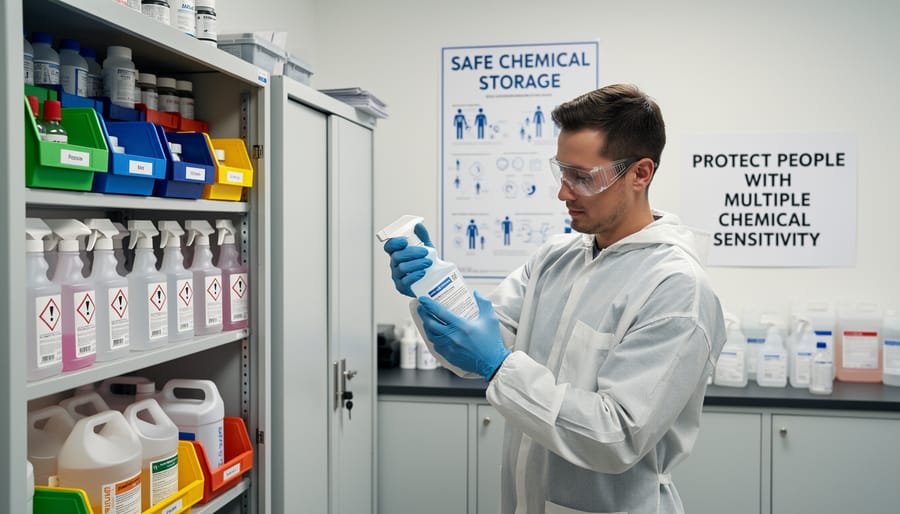
Protecting workers with Multiple Chemical Sensitivity requires concrete provisions built into your safety policy, not vague promises. Start with a comprehensive fragrance-free workplace policy that prohibits scented personal care products, air fresheners, and strongly scented cleaning supplies across all work areas. Specify which products are restricted and include clear examples employees can understand: perfume, cologne, scented lotions, fabric softeners, and plug-in air fresheners all fall under typical fragrance bans.
Ventilation requirements deserve explicit attention in your policy. Mandate adequate fresh air circulation in all work areas, establish procedures for increasing ventilation before and after any chemical use, and create designated low-chemical zones where affected workers can retreat when exposures occur. Install operable windows where feasible, and specify that heating, ventilation, and air conditioning (HVAC) systems must be maintained with unscented filters and regular inspections.
Notification procedures form another critical accommodation. Require advance notice before any painting, floor refinishing, pesticide application, or introduction of new cleaning products. Give affected workers at least 48 hours’ notice so they can arrange workplace accommodations such as temporary relocation or schedule adjustments. Document who is responsible for providing these notifications and how workers should be contacted.
Mandate the use of safer alternative products wherever possible. Your policy should require purchasing decisions to consider low-VOC paints, fragrance-free cleaning supplies, and least-toxic pest control methods. Specify that any department planning to use chemicals must first consult with occupational health staff or designated safety officers to explore alternatives.
Remote work options provide essential flexibility for workers who cannot tolerate certain workplace exposures. Include provisions allowing affected employees to work from home during high-exposure periods such as building renovations, seasonal pesticide applications, or when coworkers consistently violate fragrance policies despite reminders. Specify the process for requesting and approving remote work arrangements, keeping it streamlined rather than bureaucratic.
Finally, establish clear accountability. Designate specific individuals responsible for enforcing fragrance policies, responding to accommodation requests, and investigating exposure incidents. Without named accountability, even well-written policies fail in practice.
Success Story: Effective MCS Workplace Policy in Action
A mid-sized manufacturing facility in Southern Ontario faced a critical challenge in 2025 when three employees disclosed Multiple Chemical Sensitivity diagnoses within six months. Production floor chemicals, maintenance products, and even coworkers’ personal care products triggered severe reactions, leading to sick leave and potential human rights complaints.
The company formed a joint health and safety committee that included an affected employee as advisor. They conducted a comprehensive chemical audit, identifying 47 products in regular use. Rather than fighting the accommodations, management committed to a complete policy overhaul.
The new safety policy introduced a staged chemical substitution program, replacing high-VOC cleaners and solvents with low-odour alternatives over four months. They installed additional ventilation in three zones and created a fragrance-free workplace standard that applied to all staff, not just those with MCS. The policy included advance notification requirements: any planned chemical use now required 48-hour notice posted in common areas and sent via email, allowing sensitive workers to adjust schedules or work locations.
Training proved essential. Every employee completed a 90-minute workshop explaining MCS as a legitimate disability, not a preference. Supervisors received additional instruction on accommodation procedures and how to address resistance from coworkers.
Within eight months, sick leave among affected employees dropped 73%. Productivity increased as workers no longer lost partial days to recovery from exposures. Two employees who had considered leaving returned to full-time status. The company also discovered unexpected benefits: the safer products reduced respirator requirements for all workers, and the clear policy eliminated arguments about accommodation fairness.
The cost? Roughly $8,000 in product substitutions, $3,500 in ventilation improvements, and $2,200 in training, far less than the potential legal costs and lost expertise from employee turnover.
Common Questions About Workplace Safety Policies and MCS
Who is responsible for creating the workplace safety policy?
The employer holds primary responsibility for developing and implementing workplace safety policies. However, effective policies typically involve input from health and safety committees, workers with MCS, occupational health professionals, and human resources staff to ensure comprehensive coverage of accommodation needs.
How often should workplace safety policies be reviewed?
Policies should be reviewed at least annually, but immediate updates are necessary when new regulations emerge, workplace incidents occur, or accommodations prove inadequate. The 2026 regulatory updates to PPE requirements under the Labour Program Forward Regulatory Plan make this year a critical review point for many employers.
Can workers with MCS request changes to existing safety policies?
Yes. Workers have the right to request accommodations and policy modifications that address their chemical sensitivities. Employers must engage in good-faith discussions and implement reasonable accommodations unless doing so creates undue hardship.
What training is required for workplace safety policies addressing MCS?
All parts of Canada require employers to provide training on workplace harassment and violence policies, including procedures for reporting concerns. For MCS-specific provisions, training should cover recognition of symptoms, proper use of alternative products, notification protocols before chemical use, and emergency response procedures.
Beyond these fundamental questions, workers and employers often wonder about documentation requirements. Chemical sensitivities don’t always need extensive medical documentation to trigger accommodation discussions. While a medical note confirming MCS can strengthen requests, employers should respond to accommodation needs based on observable reactions and functional limitations. The focus should be on identifying effective solutions rather than demanding exhaustive proof.
Cost concerns frequently arise during policy development. While implementing fragrance-free policies and switching to low-chemical cleaning products involves some expense, many accommodations cost little or nothing. Remote work arrangements, improved ventilation, advance notification systems, and designated chemical-free zones often require minimal investment. Templates from organizations like OHS Manuals Canada and Empire Safety Solutions, covering provinces from BC to Quebec, can reduce the time and cost of creating compliant policies from scratch.
Enforcement varies by jurisdiction. Federal workplaces fall under Labour Program oversight, while provincial bodies handle enforcement for most other employers. Workers who believe their employer isn’t meeting policy obligations can file complaints with the relevant regulatory authority. Documentation of policy violations, accommodation requests, and employer responses strengthens these complaints and helps regulators assess compliance.
Workplace safety policies that address Multiple Chemical Sensitivity aren’t just regulatory checkboxes. They’re practical tools that protect workers’ health, reduce workplace conflicts, and create environments where individuals with MCS can contribute their skills without compromising their wellbeing. For those living with chemical sensitivities, clear written policies provide concrete protections rather than relying on informal arrangements that can shift with management changes or workplace turnover.
The 2026 regulatory landscape, including the Labour Program Forward Regulatory Plan covering 2026 to 2028 and the August 2026 modifications to the Canada Occupational Health and Safety Regulations, signals growing recognition that workplace safety must evolve to address diverse health needs. Employers who act now, rather than waiting for enforcement, position themselves as leaders in inclusive workplace practices.
Start with the fundamentals: assess your current workplace hazards, consult with affected workers, and document clear procedures. The Canadian Centre for Occupational Health and Safety offers practical resources for developing effective policies, while Environmental Health Canada provides specialized support for MCS-related accommodations. Customizable templates can accelerate the process, but remember that meaningful protection comes from implementation, not documentation alone.
Your workplace safety policy should grow with your understanding. Regular reviews, open communication, and genuine commitment to accommodation transform policies from paper requirements into lived workplace culture that benefits everyone.


